
AUTOMATION CAREERS
AUTOMATION
CAREERS
Industrial automation skills can open doors for apprentices, electricians, maintenance engineers and career changers. This pathway explains the roles, skills and learning routes.
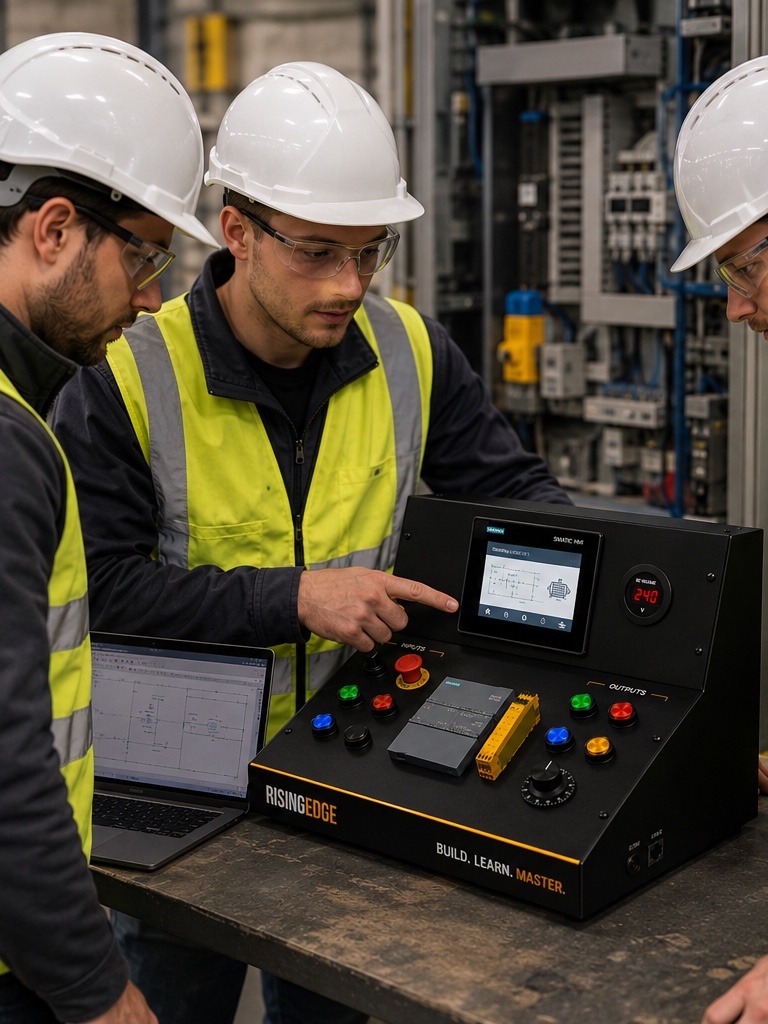
This pathway is for learners and workers who want to understand the career value of PLCs, Siemens skills and hands-on automation practice.
See where PLC skills can take you.
This pathway is for learners and workers who want to understand the career value of PLCs, Siemens skills and hands-on automation practice.
Useful for apprentices, electricians, technicians, maintenance engineers and serious self-learners.
START HERE
START HERE
Follow the guides in a sensible order. Live guides open now, planned guides show what is coming next.
Best Way To Learn PLC Programming at Home
A realistic beginner route covering PLC basics, ladder logic, TIA Portal, simulation and hands-on hardware practice.
Read the guide →How To Become a PLC Programmer
Understand the skills, practice and mindset needed to move towards PLC programming work.
Planned guideHow To Become an Automation Engineer
A practical overview of automation engineering as a career route.
Planned guideDo Electricians Need To Learn PLCs?
Explain why PLC knowledge can help electricians move into automation and controls.
Planned guideBest PLCs To Learn for Beginners
Compare beginner-friendly PLC platforms and why Siemens S7-1200 is a strong learning choice.
Planned guideHow Long Does It Take To Learn PLC Programming?
Set realistic expectations for learning PLCs properly.
Planned guideMORE PATHWAYS
KEEP BUILDING
Move between pathways as your confidence grows. Each route builds confidence step by step, from core ideas to more focused automation topics.
PLC Basics
PLCs, I/O, scan cycles and ladder logic foundations.
Explore pathway → 02Siemens & TIA Portal
S7-1200, tags, software terms and beginner Siemens workflows.
Explore pathway → 03Industrial Control
24VDC control, safety devices, relays, indicators and panel components.
Explore pathway → 04Automation Careers
Routes into PLC programming, automation engineering and upskilling.
Explore pathway →HOW AUTOMATION CAREERS BUILD FROM PRACTICAL SKILLS
A practical plain-English section to help learners understand the topic, connect it to real work and know what to practise next.
Automation careers are not only for people who write complex code all day. Many roles sit between electrical work, mechanical systems, fault finding, process improvement and software. A maintenance technician may use PLC diagnostics to find why a conveyor has stopped. A controls engineer may modify logic, commission an HMI or improve a production sequence. A panel builder may wire the hardware that makes the control system possible.
Employers value people who can connect the dots. That means understanding the sensor, the input, the PLC logic, the output device and the machine behaviour. A learner who can explain that chain clearly will usually be more useful than someone who only knows isolated theory.
A strong route is to build the fundamentals first: electrical safety, 24V DC control, inputs and outputs, ladder logic, drawings, fault finding and communication. From there, learners can move into Siemens, Rockwell, Schneider or other platforms depending on the workplace.
For UK learners, apprenticeships, maintenance roles, panel building and junior engineering posts can all become entry points into automation. The key is to show practical confidence: read a drawing, identify an IO fault, understand why a safety circuit matters, and explain a control sequence clearly.
Try this next
Pick one guide from this pathway, read it fully, then write down one real-world example and one fault you would check first. That small habit turns passive reading into practical engineering confidence.
FREQUENTLY ASKED QUESTIONS
What jobs are there in industrial automation?
Common roles include automation engineer, controls engineer, PLC programmer, maintenance technician, panel builder and commissioning engineer.
Do automation jobs require a degree?
Some roles do, but many practical routes come through apprenticeships, electrical work, maintenance, panel building and hands-on industrial experience.
Which PLC skills help most?
Inputs and outputs, ladder logic, TIA Portal or other PLC software, fault finding, electrical drawings and safe control panel practice are all valuable.
How can a beginner build confidence?
Start with practical projects, learn to read signals, practise online monitoring and build a portfolio of small working examples.
CONNECT. PROGRAM. MASTER.
READY TO LEARN
WITH REAL HARDWARE?
Rising Edge training kits are being developed to help learners build real PLC confidence through hands-on practice with professional industrial hardware.