INDUSTRIAL CONTROL
INDUSTRIAL CONTROL
BASICS
PLCs make more sense when you understand the real control components around them. This pathway covers the hardware, signals and panel devices learners meet in practical automation.
This pathway will grow into a practical reference for control components, panel devices and real industrial signals.
Learn the hardware around the PLC.
This pathway will grow into a practical reference for control components, panel devices and real industrial signals.
Perfect for learners who want to understand more than the software screen.
START HERE
START HERE
Start with the core control hardware and safety ideas that appear in real automation panels.
COMING NEXT
COMING NEXT
These planned guides show where the pathway is heading next.
What Is a Safety Relay?
A beginner-friendly explanation of safety relays and monitored safety circuits.
Planned guideWhat Is a Control Relay?
Learn how relays are used in control panels and automation systems.
Planned guideRelay vs Contactor Explained
Understand the difference between relays and contactors in practical control systems.
Planned guideCommon Control Panel Components Explained
A simple guide to the devices learners see inside real control panels.
Planned guideMORE PATHWAYS
KEEP BUILDING
Move between pathways as your confidence grows. Each route builds confidence step by step, from core ideas to more focused automation topics.
PLC Basics
PLCs, I/O, scan cycles and ladder logic foundations.
Explore pathway → 02Siemens & TIA Portal
S7-1200, tags, software terms and beginner Siemens workflows.
Explore pathway → 03Industrial Control
24VDC control, safety devices, relays, indicators and panel components.
Explore pathway → 04Automation Careers
Routes into PLC programming, automation engineering and upskilling.
Explore pathway →HOW INDUSTRIAL CONTROL FITS TOGETHER
A practical plain-English section to help learners understand the topic, connect it to real work and know what to practise next.
Industrial control is the practical layer that makes machines behave in a controlled way. It includes the power supply, control voltage, PLC, input devices, output devices, relays, contactors, protection devices and operator controls.
A beginner should not try to learn every component in isolation. It is better to follow the signal path. A sensor changes state, the PLC input turns on, the program makes a decision, an output energises, and a device in the machine changes state.
Once that flow makes sense, control panels feel much less intimidating. The panel becomes a set of smaller systems working together rather than a box full of random wires and devices.
Good industrial control learning also includes safe habits. Learners should understand why emergency stops, guards, overloads, fuses, circuit protection and isolation exist. Not every learner will design safety systems immediately, but every learner should respect the role those devices play.
Try this next
Pick one guide from this pathway, read it fully, then write down one real-world example and one fault you would check first. That small habit turns passive reading into practical engineering confidence.
FREQUENTLY ASKED QUESTIONS
What is industrial control?
Industrial control is the use of electrical, electronic and automation devices to control machines, processes and equipment.
What components are in a control panel?
Common components include PLCs, power supplies, terminals, relays, contactors, circuit protection, safety devices, sensors and operator controls.
Why do beginners learn 24V DC control?
24V DC control is common in PLC panels and helps learners understand sensors, inputs, outputs and safer control circuits.
What should I learn after industrial control basics?
Move into PLC inputs and outputs, ladder logic, emergency stops, relays, contactors and fault-finding practice.
CONNECT. PROGRAM. MASTER.
READY TO LEARN
WITH REAL HARDWARE?
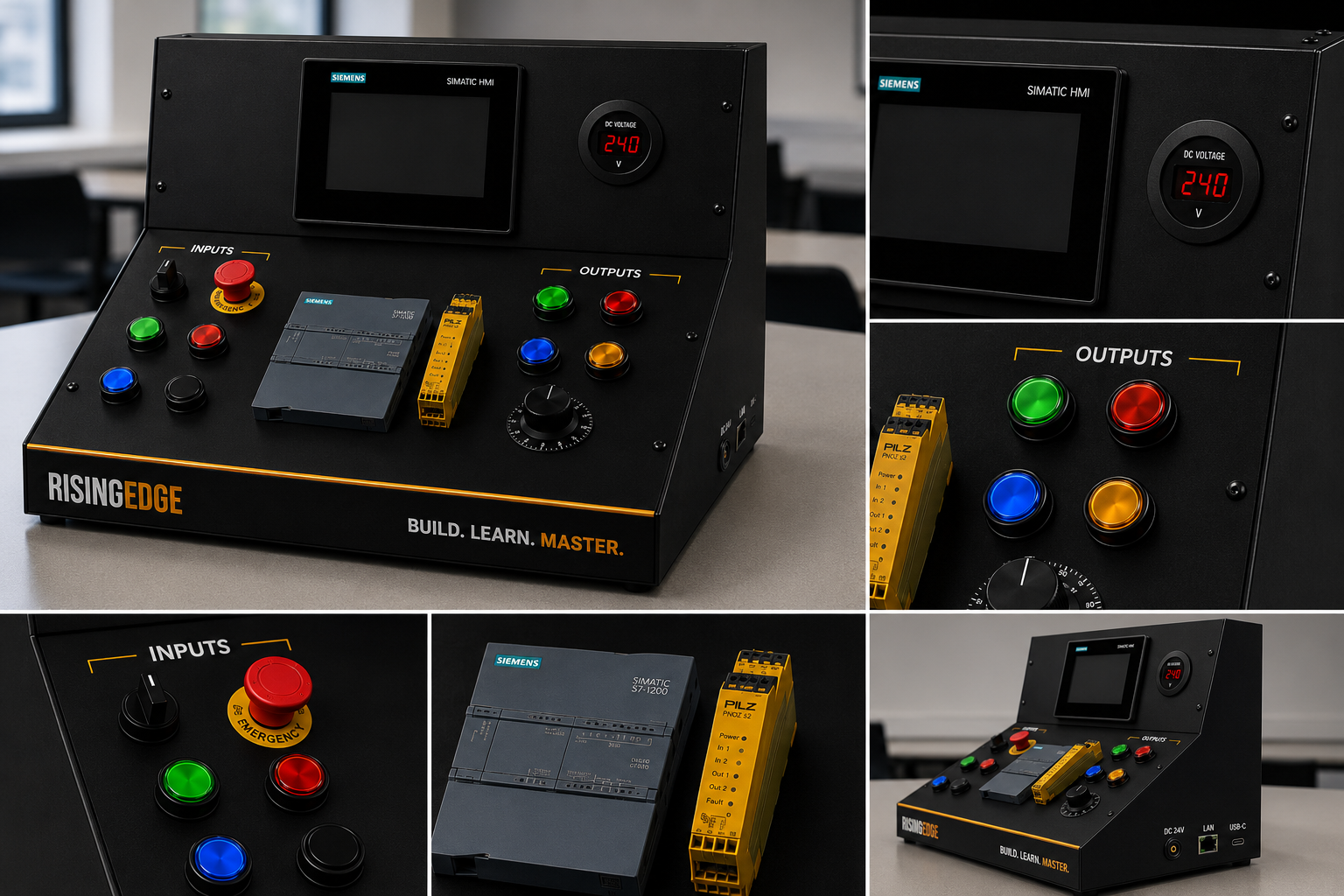
Rising Edge training kits are being developed to help learners build real PLC confidence through hands-on practice with professional industrial hardware.