
What is an emergency stop?
An emergency stop, often called an E-stop, is a safety-related control device used to stop machinery quickly when there is an emergency or dangerous situation.
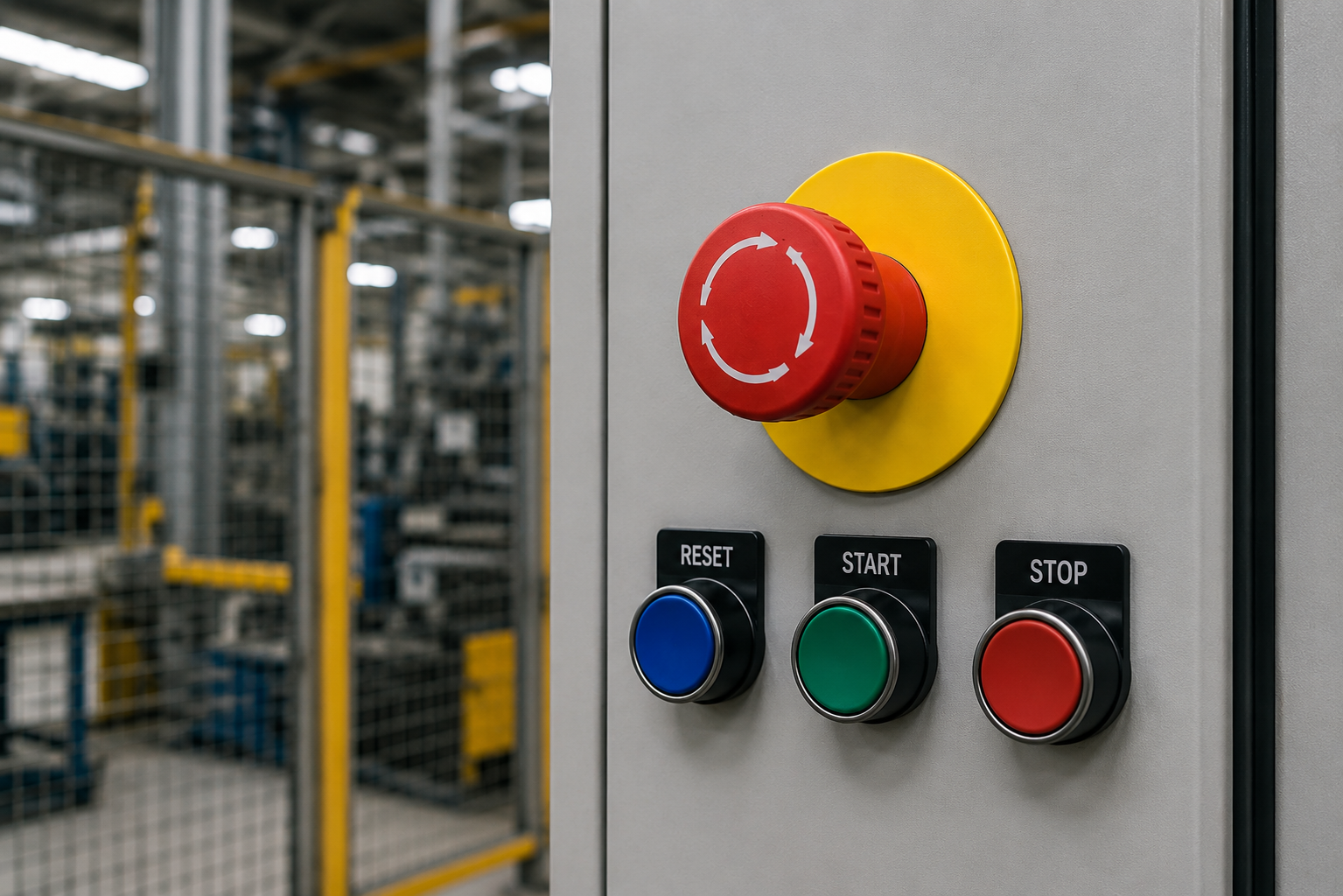
You will usually recognise it as a red mushroom-head button on a yellow background. It is designed to be easy to see and quick to operate.
Emergency stop vs normal stop button
A normal stop button is used during everyday operation. An emergency stop is for abnormal or dangerous situations.
What should an emergency stop look like?
The standard visual design is a red actuator on a yellow background. That colour combination helps people identify the emergency stop quickly, even under pressure.
A useful beginner detail is that modern guidance avoids ordinary wording or extra symbols on the red actuator or yellow background. If extra identification is needed, the recognised emergency stop symbol can be used instead.
On real machines, the exact design must be checked against the current machinery safety standards, the machine risk assessment and the components being used.
How does an emergency stop work?
In a control system, an emergency stop is normally wired into a safety circuit rather than treated like a normal PLC input only.
When the E-stop is pressed, the safety circuit changes state and the machine is brought to a safer stopped condition according to the system design. The exact stopping method depends on the machine, risk assessment and safety architecture.
Resetting an E-stop should not restart the machine
This is a key beginner point. When an emergency stop is reset, the machine should not simply start again by itself.
Resetting the E-stop only clears the emergency stop device. The system should normally require a separate, deliberate start or reset sequence before operation resumes.
Where does a safety relay fit in?
A safety relay is often used to monitor safety devices such as emergency stops and guard switches. It provides a more suitable safety-related control function than relying on ordinary PLC logic alone.
Some modern systems use safety PLCs or safety-rated controllers, but the principle is the same: safety functions must be designed with the correct hardware, wiring and validation for the risk involved.
Why E-stops matter in training
Learners often see an emergency stop as just another red button. It is much more important than that.
Good training should help learners understand the difference between control logic and safety-related control. That foundation matters before working around real machinery.
Common beginner mistakes
- Using an emergency stop as a normal stop button. Emergency stops are for hazardous situations, not routine machine control.
- Thinking an emergency stop automatically makes a machine safe. The full safety circuit, risk assessment and stopping method matter.
- Wiring safety devices like standard PLC inputs without considering safety-rated hardware. Emergency stop circuits often need safety relays or safety controllers.
- Assuming resetting an emergency stop should restart the machine. Reset should make the system ready; a separate start action is normally required.
Frequently asked questions
What is an emergency stop used for?
An emergency stop is used to stop a machine quickly when there is danger to people, equipment or the process. It is a safety function, not a normal stop control.
What is the difference between an emergency stop and a stop button?
A stop button is used for normal machine stopping. An emergency stop is reserved for hazardous situations and is normally connected through a safety-rated circuit.
Should an emergency stop be normally closed?
Emergency stop contacts are typically normally closed so that a broken wire or loss of signal can be detected as a fault or stop condition in the safety circuit.
Does an emergency stop remove power from the PLC?
Not always. Many systems keep the PLC powered so it can monitor the fault state, display alarms and support controlled recovery, while safety-rated outputs remove power from hazardous motion.
Do emergency stops need a safety relay?
Many machines use a safety relay or safety controller to monitor emergency stop devices and safely remove power from hazardous parts of the machine. The exact design depends on the risk assessment and standards.
Can an emergency stop replace guarding?
No. An emergency stop is a backup safety measure. It does not replace proper guarding, safe design, risk assessment or other required protective measures.