
What does 24V DC mean?
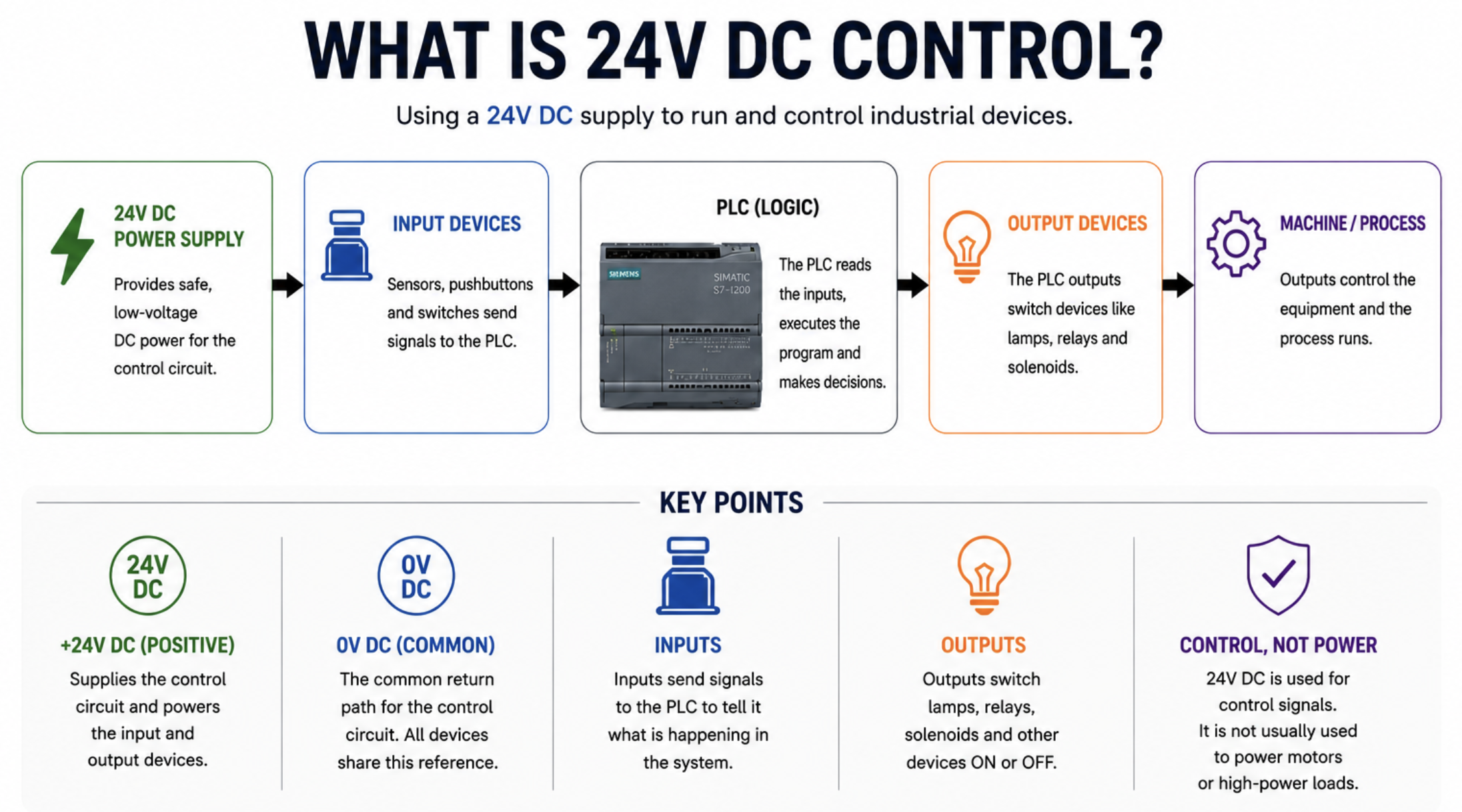
24V DC means 24 volts direct current. In industrial control, it is often used as the control voltage for signals and low-power devices.
Direct current flows in one direction. That makes it suitable for many sensors, PLC inputs, PLC outputs, relays, HMI devices and control panel components.
Why is 24V DC common in industrial control?
24V DC is widely used because it is practical, reliable and well suited to modern automation hardware. It also helps separate the control side of a system from higher-power machine circuits.
How does 24V DC link to PLC inputs and outputs?
A PLC input might look for a 24V DC signal from a pushbutton or sensor. When the signal is present, the PLC sees the input as ON.
A PLC output might provide or switch a 24V DC signal to a lamp, relay or other low-power device. The PLC program decides when that output should turn on.
Input signal
A device sends 24V DC to a PLC input.
PLC logic
The PLC checks the program conditions.
Output signal
The PLC switches a 24V DC output to control a device.
Control voltage is not the same as machine power
A beginner mistake is thinking every voltage in a control panel does the same job. It does not.
24V DC control is often used for signals and control devices. Motors, heaters and other high-power loads may use different supplies and must be designed, protected and wired correctly by competent people.
Safety and good practice
24V DC systems can still be wired incorrectly, damaged or misused. Low voltage does not mean no risk. Good design, correct protection, clear labelling and proper isolation still matter.
For learning environments, a well-designed 24V DC setup can make the core ideas easier to teach because learners can focus on inputs, outputs and control logic without unnecessary complexity.
Common 24V DC control devices
Once you start looking at automation panels, you will see 24V DC devices everywhere.
What should you learn next?
After 24V DC control, a useful next topic is the emergency stop. It is one of the most recognisable industrial control devices, but it is often misunderstood by beginners.
Why 24V DC is common in control panels
Many modern control systems use 24V DC because it is practical for sensors, PLC inputs, small relays, indicators and operator devices. It is also easier to handle in training environments than mains voltage, although it still needs correct design and safe working practices.
A typical panel may have a power supply that converts mains voltage to 24V DC. That 24V DC then feeds the PLC, sensors and control devices. When a sensor switches, the PLC input sees the change. When the PLC output turns on, it may energise a relay coil, lamp or interface device.
Understanding 24V DC helps learners read drawings and fault-find. If a sensor is not working, you can check the supply, the 0V reference, the switched signal and the PLC input status in a logical order.
Common beginner mistakes
- Treating 24V DC as harmless. It is lower risk than mains voltage, but wiring still needs correct protection, polarity and workmanship.
- Mixing up positive and negative terminals. Reversed polarity can stop devices working or damage some components.
- Assuming every 24V device is wired the same way. Sensors, PLC inputs and outputs can have different wiring requirements.
- Forgetting the power supply rating. The 24V supply must be sized for the PLC, HMI, sensors, relays and other connected loads.
Frequently asked questions
Why is 24V DC used in control panels?
24V DC is widely used because it is safer, reliable, easy to distribute and suitable for many industrial sensors, PLC inputs, relays and control devices.
Is 24V DC safe to touch?
24V DC is generally much lower risk than mains voltage, but it should still be treated properly. Control panels must be designed, wired and protected correctly.
What does DC mean?
DC means direct current. The voltage has a fixed polarity, with positive and negative terminals, unlike AC which alternates direction.
Can a PLC run on 24V DC?
Many compact industrial PLCs use 24V DC for power and IO signals, including common Siemens S7-1200 DC variants.
What happens if polarity is reversed?
Reversing polarity can stop devices working and may damage some equipment. Always check wiring diagrams, terminal markings and manufacturer instructions.
Is 24V DC the same as an output signal?
No. 24V DC is the control voltage. An output signal is how the PLC switches or sends that voltage to control another device.